
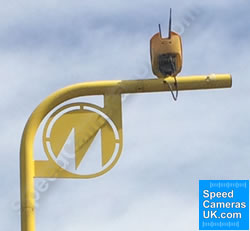
 VECTOR is an average speed camera system manufactured by Jenoptik. Like SPECS, it uses Automatic Number Plate Recognition (ANPR) technology at multiple fixed points to calculate the time your vehicle takes to travel between cameras. If your average speed across that distance exceeds the posted limit, a speeding notice is automatically issued. VECTOR cameras can monitor multiple lanes simultaneously in both directions and produce no visible flash - they read number plates passively using infrared illumination, day and night.
VECTOR cameras are found on smart motorways, dual carriageways and increasingly on urban roads. Although VECTOR has a reputation as a motorway camera, over a third of VECTOR deployments in our database enforce 30mph limits, reflecting growing use on urban roads and dual carriageways. The West Midlands has the highest concentration of VECTOR cameras of any county in the UK. Drivers caught speeding in a VECTOR zone receive the standard UK penalty: a £100 fine and 3 penalty points.
VECTOR is increasingly deployed alongside HADECS 3 on smart motorway schemes as a modern alternative to the older SPECS system. Like SPECS, VECTOR eliminates the brake-and-accelerate behaviour associated with single-point cameras, since average speed is measured across the entire enforcement zone - drivers cannot simply slow for the camera and speed up again between posts.
What is a VECTOR speed camera?
A VECTOR speed camera is a compact, fully digital average speed enforcement camera. Unlike a Gatso or Truvelo - which measure the speed of a vehicle at a single point - VECTOR calculates how fast your vehicle has travelled on average across an entire section of road between two or more camera positions. This makes it impossible to avoid a fine simply by braking at the camera and accelerating away.
VECTOR cameras are typically mounted on poles at the roadside or on central reservations, and can also be fixed to traffic signals, street lighting columns, gantries and bridges. Their compact size compared to SPECS cameras makes them easier and more cost-effective to install on existing street furniture without requiring dedicated new structures.
Beyond speed enforcement, VECTOR cameras are a multi-purpose traffic enforcement tool. A single installation can also handle:
- Bus lane enforcement
- Level crossing monitoring
- Red light enforcement
- Yellow box junction violations
- Tolling and congestion charging
- Access control
- Parking management
Note: Not all VECTOR cameras are used for speed enforcement. Only yellow VECTOR cameras are speed cameras. Units that are not painted yellow are standard ANPR cameras used for other traffic management purposes.
How do VECTOR speed cameras work?
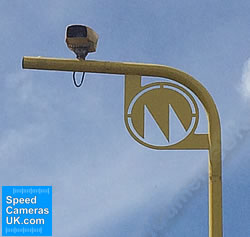 VECTOR speed camera systems are commonly used to enforce speed limits on dual carriageways and roads with bidirectional travel. Cameras are positioned at the entry and exit points of a managed speed control zone, and at regular intervals along it.
When your vehicle passes the first camera, ANPR technology reads and records your number plate along with the precise date and time. When your vehicle passes the next camera in the zone, the same information is captured again. The system then calculates the time elapsed and the distance travelled to determine your average speed between the two points. If that average exceeds the speed limit, your number plate details and photographic evidence are used to issue a speeding notice automatically.
Crucially, VECTOR cameras cannot be detected by radar or laser speed camera detectors. Because they use ANPR rather than radar or laser to trigger enforcement, only a GPS speed camera detector - which uses a pre-loaded database of camera locations - will alert you to an upcoming VECTOR zone.
Do you have a question about VECTOR average speed cameras? You can read UK motorists' VECTOR questions and answers and also submit your own unanswered question via our online form. Alternatively, read UK drivers' VECTOR average camera comments.
VECTOR vs SPECS: what is the difference?
VECTOR and SPECS cameras use identical underlying technology - ANPR-based average speed calculation between fixed points. The main differences are:
- Size: VECTOR cameras are significantly smaller and more compact than SPECS units, making them easier to mount on existing roadside infrastructure.
- Installation cost: VECTOR's smaller footprint means lower installation costs, particularly where new poles or structures are not required.
- Multi-function capability: VECTOR can enforce a broader range of traffic offences - including red light violations, bus lane contraventions, yellow box junction offences and congestion charging - in addition to average speed enforcement.
- Lane coverage: Each VECTOR unit houses two cameras, allowing it to monitor two lanes of traffic - either on a dual carriageway (same direction of travel) or in a bidirectional arrangement on a single carriageway road.
Can VECTOR catch you if you slow down at the camera?
Yes - this is one of the most important things to understand about any average speed camera system. Because VECTOR measures your average speed across the entire distance between entry and exit points, briefly slowing down as you pass a camera makes very little practical difference if you have been travelling significantly above the limit in between. The mathematics of average speed mean that even a significant reduction in speed near the camera will barely affect the overall average if the rest of the journey was at an excessive speed.
This is why average speed zones are generally considered more effective at achieving sustained compliance than point speed cameras - drivers cannot simply brake for the camera and accelerate away.
Does a VECTOR speed camera flash?
VECTOR cameras do not produce a visible flash. They use infrared illumination to capture clear number plate images in all weather and lighting conditions, day and night, without any visible light output to drivers. This means you will not see a flash even if the camera has recorded your vehicle. VECTOR cameras are also fully weatherproof and designed to operate in all conditions. Each unit includes a sun visor to prevent glare affecting image quality, along with a GPS clock, compass, accelerometer and dual light sensors to ensure accurate and consistent performance around the clock.
No film: always active
Unlike older fixed speed cameras such as the original wet-film Gatso, VECTOR cameras do not use film. There is no limit to the number of speeding vehicles they can record, and no need for periodic visits by technicians to collect and develop film. Your number plate, date and time stamp are stored digitally by each camera in the zone. If your calculated average speed between cameras exceeds the limit, a speeding notice is issued automatically without any manual intervention.
Images captured by VECTOR cameras can be transmitted in real time via communications media, or stored locally in a high-capacity onboard memory for later retrieval. The system records vehicle registration number, read confidence, time, date and camera location for every vehicle that passes.
VECTOR vs single-point cameras: what is the difference?
VECTOR works fundamentally differently from single-point speed cameras like Gatso and Truvelo. Rather than measuring your speed at one moment, VECTOR measures your average speed across a stretch of road. It is similar in principle to SPECS but manufactured by Jenoptik and capable of monitoring multiple lanes simultaneously.
| Feature | VECTOR (average speed) | Gatso (single point) |
|---|---|---|
| Speed measurement | Average over a distance | Instantaneous (single moment) |
| Manufacturer | Jenoptik | Gatsometer BV |
| Detection method | ANPR (number plate recognition) | Radar |
| Flash | No flash | Yes - bright visible flash |
| Lane coverage | Multiple lanes simultaneously | Single lane |
| Detectable by radar detectors | No (no radar emission) | Yes |
Both camera types issue the same standard penalty if you are caught speeding: a £100 fine and 3 penalty points.
VECTOR speed camera installations
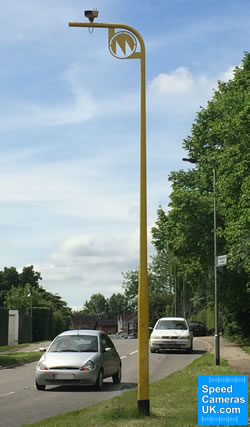 The VECTOR speed camera can be installed on traffic signals, street lighting columns, gantries and bridges, giving highway authorities considerable flexibility in where and how they deploy average speed zones. Each unit contains two cameras, allowing it to monitor two lanes of traffic - either on a dual carriageway (same direction of travel) or in a bidirectional arrangement on a single carriageway road.
A growing number of local authorities are adopting VECTOR and other average speed camera systems in preference to traditional fixed-point cameras. In Lincolnshire, for example, fixed Gatso cameras on the A15 just south of Lincoln have been replaced with a three-camera VECTOR average speed check zone. This reflects a wider national trend as the cost of average speed camera technology continues to fall and the evidence of their effectiveness in reducing speeds accumulates.
The rise in popularity of VECTOR and SPECS average speed cameras has been driven by a dramatic fall in installation costs. The cost of installing an average speed check zone fell from around £1.5 million per mile in the early 2000s to approximately £100,000 per mile by 2016, making them a practical option for a much wider range of roads and local authorities.
VECTOR speed camera locations
What is your view and experience with VECTOR speed cameras in the UK? Tell us and read more VECTOR average speed camera comments. Alternatively, if you have a question about VECTOR average speed cameras, please see our VECTOR speed camera Q&A page.
Want to know where the UK's VECTOR speed cameras are located before you drive? Here at SpeedCamerasUK.com we have a UK speed camera location database covering thousands of fixed and average speed camera sites. This database also includes Gatso, SpeedCurb, Truvelo, Truvelo D-Cam, SPECS, Peek, Traffic Light speed cameras and more. Read more about all speed camera types.
Search VECTOR camera locations in our database ->
Penalties for VECTOR speed camera offences
If you are caught speeding by a VECTOR camera in the UK, you may receive:
- £100 fixed penalty fine
- 3 penalty points added to your driving licence
- An offer to attend a speed awareness course in some cases, as an alternative to points
More serious offences - where the recorded average speed is significantly above the posted limit - may result in a court summons rather than a fixed penalty notice, potentially leading to higher fines or a driving ban. A Notice of Intended Prosecution (NIP) will be sent by post and will carry the relevant code: SP10, SP20, SP30, SP40 or SP50. For more information read our speeding fines guide. For official UK government guidance visit GOV.UK speeding penalties.