
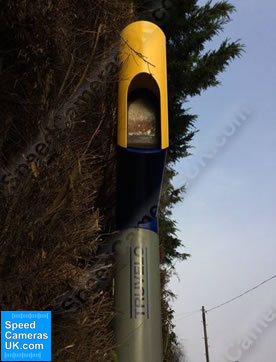
 In 2013 a new type of fully digital Truvelo speed camera was launched - the D-Cam, short for Digital Camera. Unlike the original Truvelo which is always forward-facing, and the Gatso which is always rear-facing, the D-Cam can be installed to face either direction depending on the configuration chosen by the operating force. It can also function as a red light camera and monitor up to three lanes of traffic simultaneously.
The D-Cam is fully digital with no film to collect or develop. Cameras either store up to 100,000 digital images internally or transmit them in real time via ADSL or 3G to a back-office processing system. The cost of installation is approximately £10,000, and lower running costs compared with wet-film cameras have made the D-Cam an attractive replacement for ageing Gatso installations across the UK.
Over half of all Truvelo D-Cam cameras in our database are in Norfolk, where Norfolk Constabulary installed 27 D-Cams at former Gatso sites - the most extensive D-Cam rollout by any UK force. 73% of D-Cam cameras in our database enforce 30mph limits, confirming their predominantly urban deployment.
What is a Truvelo D-Cam and how does it work?
 The Truvelo D-Cam is part of a fully digital speed camera range, mounted on poles at the side of the road or on a central reservation. The most significant step change from the original Truvelo is the elimination of film entirely. D-Cam cameras can either store up to 100,000 digital photographs internally, or transmit images in real time via an ADSL or 3G connection directly to a back-office processing system.
Where images are stored on location rather than transmitted, the camera housing conveniently lowers so that data can be downloaded to a laptop or other device on site, before being processed at the relevant police authority or Safety Camera Partnership office. This "fit and forget" approach significantly reduces the operational burden compared to traditional film-based cameras, which required technicians to visit each site regularly to collect and develop film.
The D-Cam uses one of two technologies to detect speeding vehicles and trigger the camera. The first is called D-Cam P, which uses piezo sensors embedded into the road surface. As a vehicle drives over the sensor strips and its calculated speed exceeds the limit, the D-Cam's infra-red camera is triggered to photograph the offending vehicle. The second method, D-Cam L, uses a laser beam to measure the speed of approaching vehicles. When a vehicle is detected travelling too fast, the camera activates to capture a photograph of the driver and number plate.
In both cases, the D-Cam uses an infra-red flash to illuminate the scene, producing little or no visible light for the driver. Because the D-Cam can face either direction, it may photograph the front of the vehicle (showing the driver's face) or the rear (showing the number plate), depending on how the individual installation is configured.
Do you have a question about Truvelo D-Cam speed cameras? You can read UK motorists' Truvelo D-Cam questions and answers and also submit your own unanswered question via our online form. Alternatively, read UK drivers' Truvelo D-Cam camera comments.
Does the Truvelo D-Cam flash?
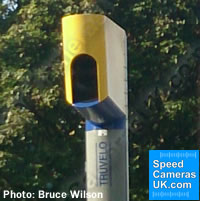
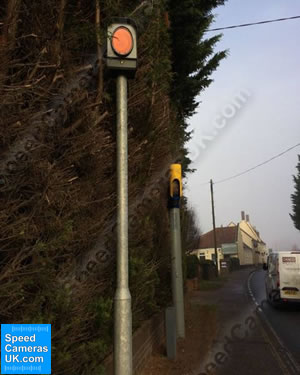
The Truvelo D-Cam does not produce a bright visible flash in the way that a Gatso speed camera does. Instead, D-Cam cameras use an infra-red flash which generates little or no visible light to the approaching driver. This is either built into the camera housing or provided by a separately mounted unit - as pictured below.
Truvelo D-Cam vs original Truvelo: what is the difference?
Both cameras share the same Truvelo heritage and use infra-red illumination, but the D-Cam introduces several significant improvements over the original Truvelo.
| Feature | Truvelo D-Cam | Original Truvelo |
|---|---|---|
| Facing direction | Either direction (configurable) | Always forward-facing |
| Detection method | Piezo sensors (D-Cam P) or laser (D-Cam L) | Piezo sensors only |
| Image storage | Fully digital - up to 100,000 images or real-time transmission | Originally film-based |
| Red light enforcement | Yes - at some sites | No |
| Lane coverage | Up to three lanes simultaneously | Single lane |
| Flash | Infra-red (no visible flash) | Infra-red (no visible flash) |
Where are Truvelo D-Cam cameras located in the UK?
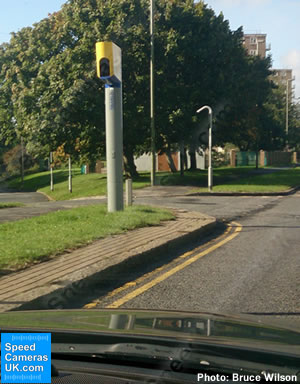 Truvelo D-Cams have been adopted by a growing number of police forces across England as the natural replacement for ageing wet-film Gatso cameras. The rollout has been most extensive in Norfolk, where 27 D-Cam units replaced former Gatso sites - more than half of all Truvelo D-Cams in the UK. Installations have also taken place in West Yorkshire and other counties.
In September 2013, two new Truvelo D-Cams were installed at accident blackspot locations in West Yorkshire that had previously been enforced by Gatso speed cameras. Because the D-Cams are configured to face approaching traffic at these sites, the photographs they capture clearly show the driver of the vehicle - leaving no doubt about who was at the wheel at the time of the offence.
Simon D'Vali, chair of West Yorkshire Casualty Reduction Partnership, commented that the new cameras on York Road were the first sites in the Leeds district to be replaced with modern digital cameras, noting the housings had been in place for 13 years and that camera technology had moved on significantly in that time. He described a rolling programme that, over 20 to 30 years, would see all of the county's cameras transition to digital. He also noted that the new digital sites transmit photographs and speed readings directly to the back office for checking, removing the need for technicians to drive to each site to collect and develop film.
Want to know where the UK's Truvelo D-Cam speed cameras are located before you drive? Our UK speed camera location database covers Truvelo D-Cam sites and thousands of other fixed camera locations. The database also includes Gatso, Truvelo, SpeedCurb, SPECS, Peek, Traffic Light cameras and more. Read about all speed camera types. You can also read UK motorists' Truvelo D-Cam comments or visit our Truvelo D-Cam Q&A page.
Penalties for Truvelo D-Cam speed camera offences
If you are caught speeding by a Truvelo D-Cam you may receive:
- £100 fixed penalty fine
- 3 penalty points added to your driving licence
- An offer to attend a speed awareness course in some cases, as an alternative to points
More serious offences - where the recorded speed is significantly above the limit - may result in a court summons rather than a fixed penalty notice, potentially leading to higher fines or a driving ban. A Notice of Intended Prosecution (NIP) will carry the relevant code: SP10, SP20, SP30, SP40 or SP50. For more information read our speeding fines guide. For official UK government guidance visit GOV.UK speeding penalties.