
 While fixed speed cameras such as the Gatso and Truvelo enforce speed limits from permanent roadside positions, mobile speed cameras give police and Safety Camera Partnerships the flexibility to enforce at any location on the road network. This unpredictability is central to their effectiveness - motorists cannot slow down at a known fixed point then accelerate away.
Mobile speed enforcement in the UK takes several forms: handheld laser guns, handheld radar guns, mobile speed camera vans, and marked and unmarked police cars. Each uses different technology with different strengths and detection characteristics.
Our database contains over 1,300 known mobile speed camera sites across the UK. Hampshire has more recorded sites than any other county, and 60% of known sites enforce 30mph limits. These are established enforcement locations - true mobile cameras can appear anywhere without notice.
How does a laser speed gun work?
Laser handheld speed camera guns fire a narrow beam of light, approximately 10cm wide, at a target vehicle. This laser beam bounces back from the vehicle's surface and the time taken for the return journey is used to calculate the vehicle's speed. A reading is produced within 0.5 seconds of the trigger being pulled, which gives laser detectors very little time to alert a driver before the measurement is complete. The effective range of a laser gun is around one mile.
The laser sight is aimed at a flat surface on the target vehicle - typically the number plate, front grille, or boot lid - to obtain the clearest possible reflection. A police officer can select and lock onto a specific vehicle in a stream of traffic with considerable precision, which is an advantage over radar in busy conditions.
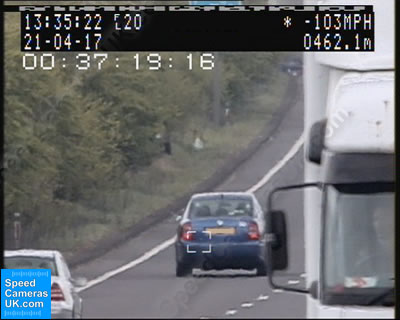
Pictured below: a vehicle is targeted by a mobile laser speed camera gun, with the laser sight aimed at the flat surface of the car boot door.
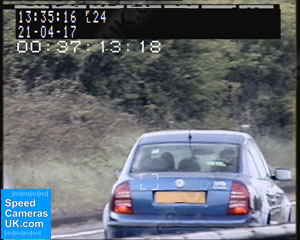
The second photo confirms the capture details:
- Time: 13:35
- Date: 21-04-17
- Distance from laser gun to vehicle: 462.1 metres
- Recorded vehicle speed: 103 mph
How does a radar speed gun work?
Radar handheld devices use radio waves to measure the speed of a passing vehicle. The device emits a beam of radio waves which reflect off the moving vehicle; the change in frequency of the returning signal - the Doppler effect - tells the device how fast the vehicle is travelling. A radar reading takes a minimum of 3 seconds for a police officer to acquire, which gives radar detectors more time to alert a driver than laser devices. The effective range of radar guns is around 300 yards.
Because radar uses a wider beam than laser, it can be more difficult to isolate a single vehicle in heavy traffic. For this reason, laser has become the more commonly used technology for point-speed enforcement in busy urban and suburban areas.
Do you have a question about mobile speed cameras? Visit our mobile speed camera questions and answers page where you can also submit your own unanswered question.
Mobile speed camera vans
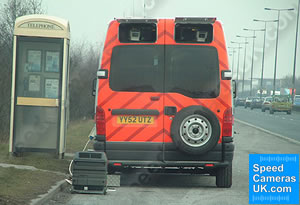
Mobile speed camera vans are a familiar sight on UK roads. These are typically liveried vehicles - often white or yellow - operated by Safety Camera Partnerships or police forces. The van parks in a location where speeding is a problem, and a camera operator runs the equipment from inside.
Many mobile vans use a mini-Gatso setup: a compact version of the standard Gatso radar speed camera mounted on a tripod inside or outside the van, measuring speed with radar and taking photographs of speeding vehicles. Like the fixed Gatso, these systems produce a visible flash and photograph the rear of the vehicle.
Mobile vans must be clearly visible to approaching motorists - they cannot be deliberately concealed. However, they are free to operate at any suitable location, and the absence of advance warning signs (beyond the legal minimum) can catch many drivers off guard.
Marked and unmarked police cars
Police officers have several tools available beyond dedicated camera equipment. One of the most straightforward is the follow check - where an officer follows a suspected speeding vehicle for a minimum of two-tenths of a mile (1,056 feet) and records its speed using the police vehicle's own certified and calibrated speedometer. Depending on the recorded speed, the officer may issue a verbal warning, a Notice of Intended Prosecution (NIP), or refer the case for court proceedings.
This technique can be used by both marked and unmarked police cars, making it difficult for motorists to identify when it is being applied. The key legal requirement is that the police vehicle's speedometer must be certifiably and regularly calibrated - without this, any evidence gathered would not be admissible.
"5:22am and dark. I was approaching the entry to the M40 southbound and noticed a police car parked on a motorway bridge facing me on the pavement - the speed limit drops to 40 from 50 there. I think I wasn't over 40, but I thought it was a bit sneaky if he was targeting cars coming towards him. He had his headlights on which masked the fact it was a police car." Comment from a UK motorist.
Speeding campaigns and community speed watch
Police forces across the UK run dedicated speeding campaigns throughout the year, with particular intensity during busy periods such as school holidays, bank holidays, and the festive season when more motorists are on the road. During these campaigns, mobile enforcement activity is typically increased at known problem locations.
At a community level, some local councils and police forces run Community Speed Watch schemes, where trained volunteers use laser speed detection equipment to record vehicles exceeding the limit through their village or town. These volunteer-recorded observations cannot in themselves result in a prosecution, but the data is passed to the police and can result in a warning letter being sent to the registered keeper, and persistent offenders may be flagged for follow-up enforcement.
Do mobile speed cameras flash?
Whether a mobile speed camera produces a visible flash depends on the type of system in use. Mobile vans operating a mini-Gatso radar setup will produce a visible white flash, similar to a fixed Gatso camera. Laser guns and many newer mobile systems do not produce a visible flash - they use infrared or passive illumination to capture images. If you are driving at night and see a bright flash from the side of the road or from a parked vehicle, it is very likely you have been photographed by a mobile camera.
Penalties for mobile speed camera offences
Being caught by any type of mobile speed camera carries the same penalties as any other speed enforcement method in the UK:
- £100 fixed penalty fine
- 3 penalty points added to your driving licence
- An offer to attend a speed awareness course in some cases, as an alternative to points
More serious offences - where the recorded speed is significantly above the posted limit - may result in a court summons rather than a fixed penalty notice, potentially leading to higher fines or a driving ban. A Notice of Intended Prosecution (NIP) will carry the relevant code: SP10, SP20, SP30, SP40 or SP50. For more information read our speeding fines guide. For official UK government guidance visit GOV.UK speeding penalties.