Answers to the most common questions UK motorists ask about Gatso speed cameras - covering how they work, what happens when you are flashed, white road markings, film versus digital cameras, and what to do if you receive a Notice of Intended Prosecution.
SpeedCamerasUK.com does not operate any UK speed cameras and has no connection to UK Government, the Police, or any Safety Camera Partnership. We are unable to advise on individual speeding cases or the progress of a speeding offence. If you have a question not answered below, please use our contact form.
Rear-facing operation
Does a Gatso camera only catch vehicles from the rear?
Yes. Gatso speed cameras are rear-facing and capture two photographs of the back of a speeding vehicle, including the rear number plate. They cannot prosecute a driver who is travelling towards the camera.
I was flashed by a Gatso while driving towards it. Will I receive a fine?
Almost certainly not. Gatso cameras are calibrated to photograph the rear of vehicles travelling away from the camera. If you were driving towards it, the camera cannot record your rear number plate or confirm your speed via the road markings. If you do receive a Notice of Intended Prosecution, contact the issuing force and ask for photographic evidence.
Can a Gatso catch speeding vehicles on both sides of the road at the same time?
No. A single Gatso can only target one direction of traffic at a time. It can be turned periodically to face the opposite direction, but it cannot catch vehicles travelling in both directions simultaneously. Two separate cameras would be required to cover both directions at once.
The camera was on the other side of the road facing me and it flashed - am I caught?
No. A Gatso on the opposite carriageway facing towards you is targeting vehicles travelling away from it on that side of the road - not you. As long as you were not on the camera's side of the road driving away from it, you have nothing to worry about.
I was driving towards a Gatso on the other side of the road and was well over the speed limit. Will I be prosecuted?
If the camera was on the opposite side of the road and you were driving towards it, the Gatso would not have been able to capture your rear number plate or use the road markings to confirm your speed. Gatso cameras target vehicles travelling away from the lens. If you are unsure which type of camera it was, check our camera types guide - forward-facing cameras such as Truvelo and VECTOR can record approaching vehicles.
Do Gatso cameras in overhead motorway gantries also flash?
Yes. Gatso cameras are commonly used in variable speed limit gantries on smart motorways and they do flash when triggered. The same rear-facing principles apply.
White road markings
Why are white lines painted on both sides of the road near a Gatso?
White lines serve as a secondary speed-measurement tool. Two photographs taken in quick succession show how far the vehicle has travelled relative to the lines, confirming the speed recorded by the camera's radar. Lines on both sides of the road usually mean one of two things: the camera can be periodically turned to face the opposite direction, or the lines on the far side are painted purely as a deterrent to slow traffic heading both ways.
Are the white lines required for a successful prosecution?
Not always. The lines are used as a secondary measure. The Gatso's built-in radar provides the primary speed reading, and prosecutions have been made where the lines were absent or had worn away. That said, clear markings strengthen the evidence considerably.
A vehicle on the opposite side triggered the camera while I was on the white lines. Will the lines exonerate me?
Yes - the painted lines are used as exactly this kind of secondary measure. The lines show how far a vehicle moved between the two photographs. If your vehicle was stationary or travelling within the speed limit when the camera fired, the road markings will confirm that and there is no case to answer.
Does a Gatso camera need white lines to operate?
No. The camera is triggered by its built-in radar, which detects the speed of an approaching vehicle independently of the road markings. The white lines are used to calculate speed from the two photographs as a secondary confirmation. Some Gatso locations operate without road markings, though this is less common.
Flashing and triggering
Can a Gatso flash without the flash being visible to the driver?
Yes. In daylight or well-lit conditions a Gatso can capture a clear photograph without the flash being noticeable. The flash unit is primarily needed during hours of darkness to illuminate the vehicle sufficiently for the photograph. In bright daylight you may not see the flash at all, even if the camera has triggered.
If I slow down before the first white line, will I still get a ticket?
If you are driving at or below the speed limit as you pass the camera you should be fine. However, the Gatso triggers via radar very quickly when it detects a speeding vehicle, so braking as you reach the first line may already be too late. The radar reading is taken before the photographs are captured.
The camera flashed once, not twice - does that mean I have not been caught?
A Gatso is designed to take two photographs in quick succession, producing a double flash. A single flash or no visible flash does not necessarily mean the camera did not fire - in good daylight conditions the flash may not be obvious. If you were travelling over the speed limit when passing the camera, you should not assume you are in the clear.
Do Gatso cameras sometimes flash for no reason?
Yes. Gatso cameras are occasionally known to flash without recording a speeding offence - this can be caused by a fault, a power surge, or another vehicle triggering the radar. A flash alone is not confirmation that you have been caught speeding.
Will a Gatso flash even if it has run out of film?
Yes. Wet-film Gatso cameras can flash even when there is no film remaining, because the flash and the radar operate independently of whether film is loaded. Without film - or a working digital storage system in newer cameras - no usable evidence would be captured.
Film vs digital Gatso cameras
What is the difference between a wet-film Gatso and a digital Gatso?
A wet-film Gatso uses photographic film that must be physically collected and developed by technicians, and the camera will eventually run out. A digital Gatso stores images electronically on a hard drive, never runs out, and can operate continuously around the clock. Both versions are rear-facing and work on the same radar-triggered principle. Digital Gatsos are increasingly common across the UK's road network.
Do digital Gatso cameras still take two photographs?
Yes. Digital Gatso cameras capture two images in quick succession, just like the older wet-film versions. The photographs show the vehicle's position relative to the white road markings, confirming the speed recorded by the radar.
Are old-style Gatso housings sometimes fitted with newer camera technology inside?
Yes. Some older yellow Gatso housings that once contained wet-film cameras have been upgraded internally with digital technology. An old-looking box does not necessarily mean the camera is inactive or obsolete. In many areas, fixed-point cameras are also being replaced by average speed camera systems, which monitor speed over a longer distance rather than a single point.
How many hours a day is a Gatso camera active?
Digital Gatso cameras can operate 24 hours a day, seven days a week - they do not have set active hours. Older wet-film cameras were limited by film capacity and maintenance requirements. You should not assume any Gatso camera is switched off at certain times of day.
Fines, NIPs, and what to do next
I have received a speeding fine - how can I check the photographic evidence?
You are entitled to request the photographic evidence from the Police force or Safety Camera Partnership that issued the Notice of Intended Prosecution. The photographs will show your vehicle's position relative to the white road markings, confirming the speed calculation. You can also request the camera's calibration certificate, which records the distance between the painted lines at that specific location.
What is the distance between the white lines on the road?
The distance between painted white lines differs from location to location. SpeedCamerasUK.com does not hold calibration data for individual cameras. You will need to contact the Police force or Safety Camera Partnership that issued the notice - each camera has its own calibration certificate containing this information.
How long do I have before receiving a Notice of Intended Prosecution?
A Notice of Intended Prosecution must be sent to the registered keeper of the vehicle within 14 days of the alleged offence. If you do not receive one within that period, the prosecution may not be able to proceed, though there are some exceptions. Our NIP guide explains the process in detail.
I was parked nearby when another vehicle triggered the camera and I received a fine - what can I do?
Contact the issuing Safety Camera Partnership and ask for the photographic evidence. The Gatso uses two photographs and road markings to confirm speed - if your vehicle was stationary, the images would show no movement between the two frames. Presenting evidence of your vehicle's position (such as GPS tracker data or witness statements) has led to incorrectly issued fines being cancelled in documented cases. The prosecuting authority is the correct point of contact - not SpeedCamerasUK.com.
Got a Gatso question not answered above? Use our contact form to send it to us. Please note we cannot provide legal advice or comment on individual speeding cases.
Disclaimer: Answers published on SpeedCamerasUK.com represent the views of the site and its contributors. SpeedCamerasUK.com is not connected to any UK Police force, local authority, or Safety Camera Partnership.


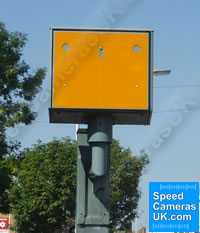 Answers to the most common questions UK motorists ask about Gatso speed cameras - covering how they work, what happens when you are flashed, white road markings, film versus digital cameras, and what to do if you receive a Notice of Intended Prosecution.
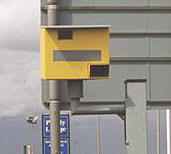 White lines serve as a secondary speed-measurement tool. Two photographs taken in quick succession show how far the vehicle has travelled relative to the lines, confirming the speed recorded by the camera's radar. Lines on both sides of the road usually mean one of two things: the camera can be periodically turned to face the opposite direction, or the lines on the far side are painted purely as a deterrent to slow traffic heading both ways.
 Yes. In daylight or well-lit conditions a Gatso can capture a clear photograph without the flash being noticeable. The flash unit is primarily needed during hours of darkness to illuminate the vehicle sufficiently for the photograph. In bright daylight you may not see the flash at all, even if the camera has triggered.
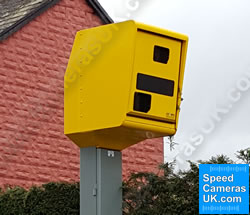 A wet-film Gatso uses photographic film that must be physically collected and developed by technicians, and the camera will eventually run out. A digital Gatso stores images electronically on a hard drive, never runs out, and can operate continuously around the clock. Both versions are rear-facing and work on the same radar-triggered principle. Digital Gatsos are increasingly common across the UK's road network.
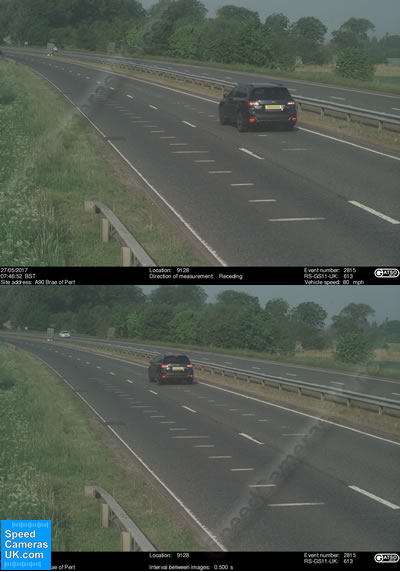 You are entitled to request the photographic evidence from the Police force or Safety Camera Partnership that issued the